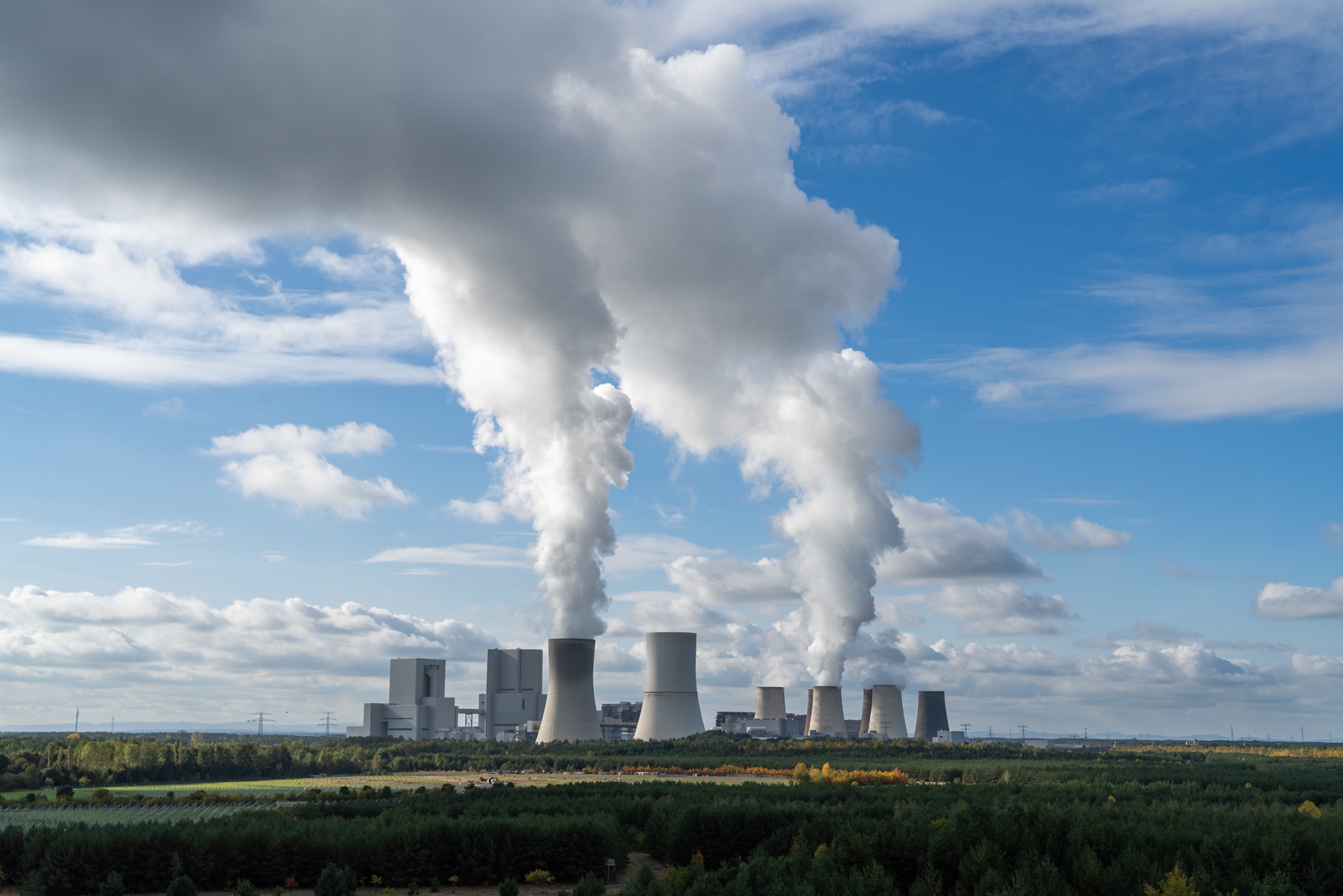
Turm und Taxis is a series of photographs of cooling towers. All were made at coal-fueled power stations in England and Germany. In England, the last coal-fueled station closed in 2025, while in Germany, they remain in operation because gas supplies from Russia were cut.
The shape of the cooling tower does not originate from aesthetics or symbolism, but from pure physics and structural logic. The classical cooling tower is a hyperboloid; it combines maximum efficiency with structural strength.
After the Second World War, the hyperboloid cooling tower became standard for coal-fired and nuclear power plants. A cooling tower is a system designed to cool the hot water generated by the turbines that produce electricity. The method of heating water depends on the fuel source — whether it is fossil or nuclear. Inside the tower, the hot process water is cooled with water taken from a river or another source. Part of that water evaporates, and the resulting vapour leaves the tower through the chimney. The visible plume is damp. Pollution comes from the power station itself, from the fuel used to generate the steam that drives the turbines.
The basic principle — heating water to create steam to power machines — launched the Industrial Revolution. We are at the beginning of a data revolution. The processing of enormous amounts of data (AI is an example) requires very high levels of energy.
The iconic or monumental appearance of cooling towers is therefore a by-product. The form is the direct outcome of gravity, heat, water, concrete, and efficiency. Any symbolic meaning associated with the cooling tower was added later by human interpretation.